

Common High-Mileage Transmission Problems and the Best Replacement Approach

Common High-Mileage Transmission Problems and the Best Replacement Approach
Driving in the heavy stop-and-go traffic of Washington, D.C., navigating the bustling urban grid of Philadelphia, Pennsylvania, or commuting between Baltimore, Maryland, and Wilmington, Delaware, puts immense strain on your vehicle’s drivetrain. Over time, this daily grind takes a toll on one of your car’s most complex and vital components: the transmission. For vehicles crossing the 100,000-mile mark, transmission wear is an inevitable reality. Understanding the early warning signs of transmission failure and knowing the most cost-effective, reliable replacement strategy can save you thousands of dollars.
Recognizing High-Mileage Transmission Problems
Modern automatic and manual transmissions are marvels of engineering, relying on a precise combination of hydraulics, electronics, and mechanical friction to transfer engine power to the wheels. When a vehicle accumulates high mileage, the internal components naturally degrade. Here are the most common technical failures you will encounter.
1. Slipping Gears and Loss of Engagement
Transmission slipping occurs when the engine revs (RPMs spike), but the vehicle fails to accelerate correspondingly. In automatic transmissions, this is typically caused by worn clutch packs, degraded transmission bands, or a failing torque converter. As the friction material on the clutch plates wears down over tens of thousands of miles, the hydraulic pressure required to hold the gear is compromised. If you are merging onto I-95 in Wilmington and feel a sudden disconnect between engine speed and vehicle speed, your transmission is likely slipping.
2. Delayed or Rough Shifting
A healthy transmission should transition between gears seamlessly. High-mileage vehicles often develop “shift shock”—a hard clunk or violent jerk when moving from Park to Drive, or between forward gears. This is frequently linked to a failing valve body or malfunctioning shift solenoids. The valve body directs hydraulic fluid through a maze of channels to actuate gear changes. When debris from internal wear clogs these channels, or the electronic solenoids degrade, the timing of the hydraulic pressure is thrown off, resulting in harsh engagements.
3. Transmission Fluid Leaks and Degradation
Transmission fluid is the lifeblood of the system, acting as a hydraulic fluid, a lubricant, and a coolant. Over time, the intense heat generated by city driving in places like Baltimore and Philadelphia causes the fluid to break down, oxidize, and lose its lubricating properties. Furthermore, high-mileage seals and gaskets (like the pan gasket, axle seals, or front pump seal) become brittle and shrink, leading to leaks. Low fluid levels cause an immediate drop in hydraulic pressure, leading to catastrophic internal damage if left unaddressed.
📹 Recommended Video
For a visual guide, search “diagnosing high mileage transmission problems” on
YouTube.
The True Cost of Transmission Replacement
When a transmission fails, vehicle owners are faced with a difficult decision: rebuild, buy new, buy aftermarket, or source a used OEM replacement. To make an informed decision, we must look at the data.
| Replacement Option | Estimated Cost | Reliability & Fitment | Pros & Cons |
|---|---|---|---|
| Brand New (Dealership) | $3,500 – $7,000+ | Excellent | Pros: Factory warranty. Cons: Prohibitively expensive, often exceeding the value of a high-mileage car. |
| Cheap Aftermarket / Rebuilt | $1,500 – $3,500 | Low to Moderate | Pros: Lower initial cost than new. Cons: High failure rate, poor fitment, inferior internal components. |
| Used OEM Parts | $800 – $2,000 | High (if tested) | Pros: Exact factory specifications, highly cost-effective. Cons: Requires sourcing from a reputable supplier. |
Why Used OEM Parts Outperform Cheap Aftermarket Alternatives
A common trap for budget-conscious drivers is turning to cheap aftermarket parts or questionable rebuilt units. While the upfront price tag might look appealing, the long-term reality is often a nightmare of recurring mechanical issues. Here is exactly why choosing OEM parts (Original Equipment Manufacturer) is the superior approach.
The Danger of Aftermarket Tolerances
Transmissions operate on microscopic tolerances. Aftermarket manufacturers often reverse-engineer parts, cutting corners on metallurgy and machining precision to keep costs down. An aftermarket solenoid or sensor might not communicate perfectly with your vehicle’s Powertrain Control Module (PCM), leading to immediate shift issues. By contrast, used auto parts sourced directly from a factory-built vehicle guarantee exact dimensional and electronic compatibility.
The Value of Factory Assembly
A transmission assembled in a controlled factory environment by the original automaker possesses a level of build quality that third-party rebuilders struggle to match. When you purchase a used OEM transmission, you are getting a unit that was built to the manufacturer’s exact, rigorous standards. This is why savvy mechanics and DIY enthusiasts across the Mid-Atlantic rely on high-quality recycled car parts to keep their vehicles on the road.
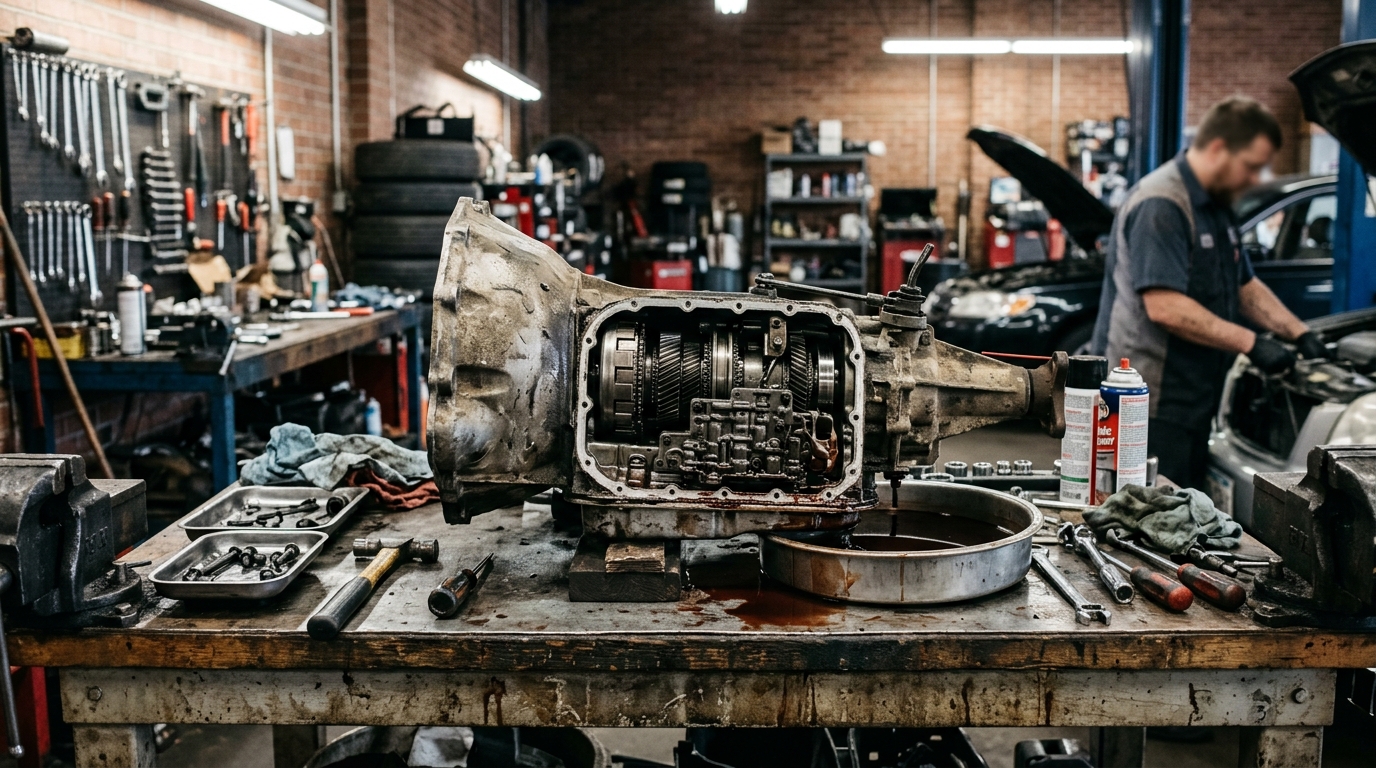
used transmission workbench
The Best Replacement Approach for Mid-Atlantic Drivers
If you live in Washington, D.C., Baltimore, Philadelphia, or Wilmington, your best approach to fixing a blown transmission is sourcing a low-mileage, tested, used OEM transmission from a trusted supplier like JP Auto Hub.
Here is a step-by-step approach to replacing your high-mileage transmission:
- Verify the Diagnosis: Before condemning the transmission, have a certified technician check the PCM for diagnostic trouble codes (DTCs). Sometimes, a simple speed sensor or low fluid level mimics a total failure.
- Match the VIN: Transmissions vary wildly even within the same make and model year. Always use your Vehicle Identification Number (VIN) to ensure you are sourcing the exact match.
- Source Quality Recycled Car Parts: Avoid junkyard gambles. Purchase your replacement from a facility that inspects, cleans, and tests their inventory.
- Replace Wear Items During Install: While the transmission is out, it is the perfect time to replace the rear main engine seal, transmission mounts, and axle seals.
- Perform a Proper Fluid Flush: Never reuse old transmission fluid. Fill the replacement OEM unit with the exact fluid specification required by the manufacturer.
How to Source Your Replacement Transmission with JP Auto Hub
At JP Auto Hub, we specialize in providing top-tier used auto parts to drivers and mechanics. We understand that a transmission failure is stressful, which is why we take the guesswork out of the replacement process. Our inventory of OEM parts is rigorously inspected to ensure you receive a reliable, ready-to-install unit.
Instead of overpaying at the dealership or rolling the dice on inferior aftermarket components, browse our extensive inventory. You can Shop directly on our website for your specific make and model. We proudly serve the automotive needs of the greater Baltimore, Philadelphia, Washington D.C., and Wilmington areas, delivering quality parts right to your door or preferred repair shop.
If you are unsure which transmission code matches your vehicle, or if you need assistance verifying fitment, our team of automotive experts is here to help. Reach out to us via our Contact page, and let us help you get your vehicle back on the road safely and affordably.





Copyright 2025 © J&P All right reserved. Powered by IzyoX
