
The Environmental Impact of Auto Recycling: Why Buying Used is Green
The Environmental Impact of Auto Recycling: Why Buying Used is Green
The automotive industry is undergoing a massive shift toward sustainability. While much of the global conversation centers around electric vehicles and alternative fuels, one of the most immediate and impactful ways to reduce our carbon footprint lies in the maintenance and repair of the vehicles already on the road. Auto recycling is a multi-billion-dollar industry that plays a critical, yet often underappreciated, role in global environmental conservation. At JP Auto Hub, we believe that choosing recycled car parts is not just a financially savvy decision—it is a vital ecological imperative.
Every year, millions of vehicles reach the end of their usable life. If left in landfills, these vehicles would leak toxic fluids into the groundwater and waste millions of tons of reusable steel, aluminum, and advanced polymers. By harvesting and refurbishing used auto parts, the auto recycling industry actively prevents ecological disasters while significantly reducing the demand for new manufacturing. In this comprehensive guide, we will explore the deep technical realities of automotive manufacturing, the rigorous processes of modern auto recycling, and why buying used OEM parts is the ultimate green choice for drivers across the Mid-Atlantic.
The True Carbon Cost of Manufacturing New Auto Parts
To truly understand the environmental impact of auto recycling, we must first examine the immense energy and resource consumption required to manufacture a brand-new car part. Modern vehicles are complex machines constructed from specialized alloys, high-strength steel, lightweight aluminum, and complex petrochemical plastics. The creation of these materials from raw earth is incredibly carbon-intensive.
The Metallurgy of Automotive Steel and Aluminum
Consider the production of a new steel door shell or an engine block. The process begins with the extraction of iron ore through open-pit mining, a practice that requires massive diesel-powered machinery, leading to deforestation and habitat destruction. The raw ore must then be transported to a smelting facility, where it is subjected to temperatures exceeding 2,500°F (1,370°C) in a blast furnace. This process alone releases massive amounts of carbon dioxide (CO2) and sulfur dioxide (SO2) into the atmosphere.
Aluminum, prized for its lightweight properties in modern engine blocks and suspension components, is even more energy-intensive. The extraction of bauxite ore is followed by the Bayer process to produce alumina, which is then subjected to the Hall-Héroult electrolytic process. It takes roughly 14,000 to 15,000 kilowatt-hours (kWh) of electricity to produce a single metric ton of new aluminum. In contrast, recycling existing aluminum auto parts requires only 5% of the energy needed to produce new aluminum, saving up to 95% of the associated greenhouse gas emissions.
Energy Consumption and Emissions Comparison
| Material | Energy to Manufacture New (per ton) | Energy to Recycle (per ton) | Energy Savings (%) |
|---|---|---|---|
| Aluminum | ~14,000 kWh | ~700 kWh | 95% |
| Steel | ~6,000 kWh | ~1,500 kWh | 75% |
| Automotive Plastics | ~25,000 kWh | ~3,500 kWh | 86% |
How Modern Auto Recycling Works: A Technical Breakdown
The days of the disorganized, oil-soaked “junkyard” are long gone. Today’s auto recycling facilities operate as highly regulated, technologically advanced dismantling operations. When a vehicle arrives at a recycling facility, it undergoes a strict, environmentally conscious dismantling protocol.
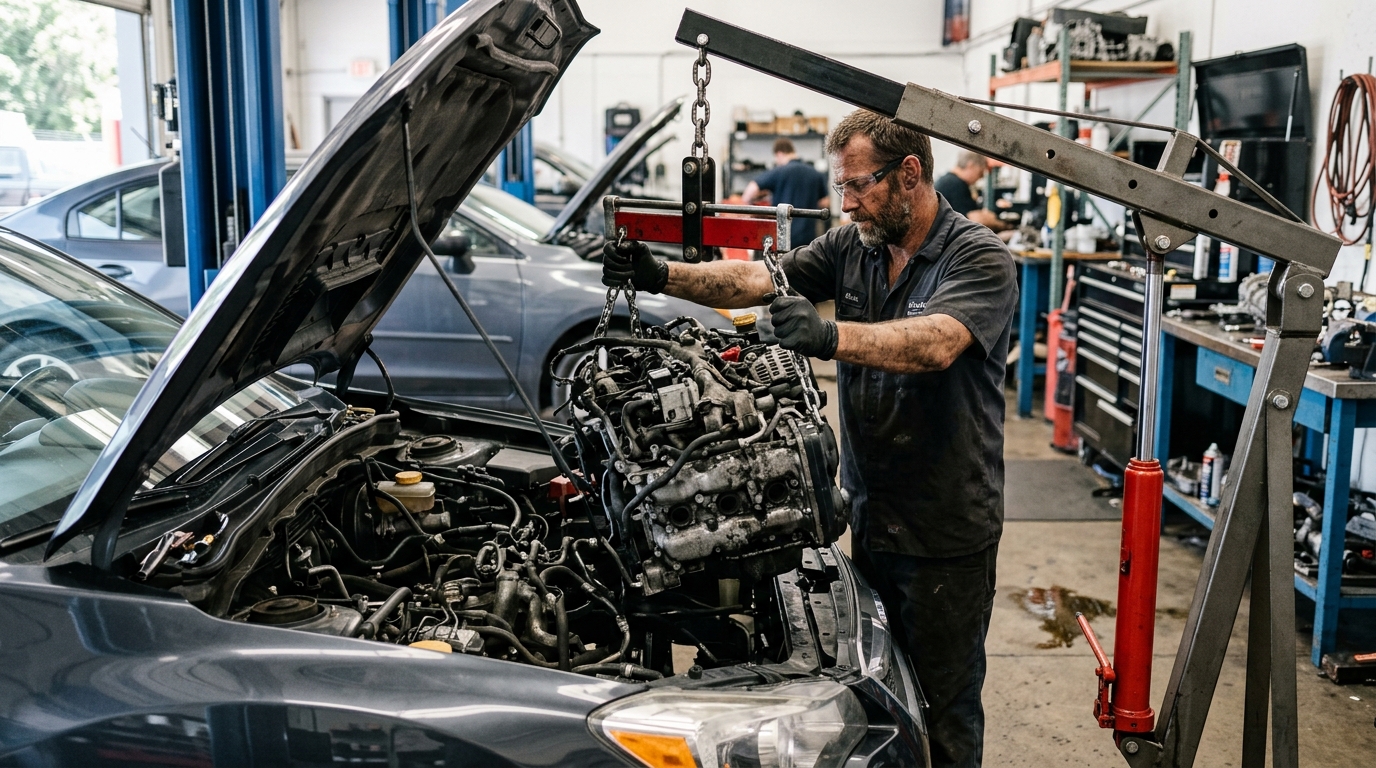
mechanic removing car engine
1. Depollution and Fluid Recovery
The most critical step in the recycling process is depollution. Vehicles are placed on specialized racks where trained technicians drain and safely store all hazardous fluids. This includes engine oil, transmission fluid, antifreeze, brake fluid, and power steering fluid. Even the Freon (refrigerant) from the air conditioning system is carefully evacuated using sealed recovery machines to prevent ozone depletion. These fluids are either filtered and reused or sent to specialized chemical processing plants for safe disposal or refinement.
2. Component Harvesting and Quality Control
Once depolluted, the vehicle is meticulously dismantled. High-value OEM parts such as engines, transmissions, alternators, body panels, and infotainment systems are carefully removed. Each part is inspected for wear, tested for functionality, and cleaned. At JP Auto Hub, these parts are then cataloged in a digital inventory system, allowing customers to easily find the exact match for their vehicle.
3. Material Shredding and Sorting
After all usable recycled car parts have been harvested, the remaining vehicle shell—often called the “hulk”—is sent to an industrial shredder. The shredder reduces the car to fist-sized chunks of metal in seconds. Powerful electromagnets separate the ferrous metals (steel and iron) from the non-ferrous metals (aluminum, copper, brass) and “fluff” (plastics, rubber, glass). These separated materials are then sold back to foundries and manufacturers to build new products, creating a closed-loop automotive lifecycle.
Why Used OEM Parts Beat Cheap Aftermarket Alternatives
When faced with a vehicle repair, consumers generally have three options: buy a brand-new OEM part from the dealer (which is incredibly expensive), buy a cheap aftermarket part, or buy a used OEM part from a reputable recycler like JP Auto Hub. From both an engineering and environmental standpoint, buying used OEM parts is vastly superior to purchasing cheap aftermarket alternatives.
The Engineering Reality of Aftermarket Parts
Aftermarket parts are manufactured by third-party companies that do not hold the original blueprints or patents for the vehicle. To avoid copyright infringement and keep costs low, these manufacturers reverse-engineer the components. This often results in slight dimensional inaccuracies. A fender might have gaps that don’t align, or an alternator bracket might be off by a millimeter, causing premature belt wear.
Furthermore, to undercut the price of OEM components, aftermarket manufacturers frequently use inferior metallurgy and lower-grade plastics. An aftermarket control arm may look identical to the original, but if it is cast from a lower-grade steel alloy, its tensile strength and crash-safety ratings are compromised. OEM parts, on the other hand, are engineered to the exact specifications, safety standards, and tolerances dictated by the automaker.
The Environmental Deficit of Aftermarket Manufacturing
Choosing a cheap aftermarket part is also an environmental misstep. When you buy a newly manufactured aftermarket part, you are still driving the demand for raw material extraction, smelting, and global shipping. The majority of cheap aftermarket parts are manufactured overseas and shipped via massive cargo vessels that burn heavy bunker fuel, contributing heavily to global greenhouse gas emissions. By purchasing used auto parts, you are utilizing an existing resource, completely bypassing the carbon emissions associated with new manufacturing and overseas shipping.
Serving the Mid-Atlantic: JP Auto Hub’s Eco-Friendly Mission
The environmental benefits of auto recycling are amplified when parts are sourced locally. Shipping heavy automotive components across the country requires significant diesel fuel consumption by freight trucks. By serving the local Mid-Atlantic region, JP Auto Hub minimizes the “parts miles”—the distance a part must travel to reach the consumer.
We are proud to provide high-quality recycled car parts to drivers and mechanics in Dover, Delaware, and Newark, Delaware. Our reach extends into major metropolitan hubs, offering fast, eco-friendly parts solutions to the bustling automotive communities in Philadelphia, Pennsylvania, and Baltimore, Maryland. By sourcing your parts regionally through our Shop, you are supporting a local circular economy, reducing freight emissions, and keeping your hard-earned money within the regional community.
The Economic and Ecological Symbiosis
The beauty of auto recycling is that the environmental benefits perfectly align with economic incentives. You do not have to pay a “green premium” to make an eco-friendly choice. In fact, purchasing recycled OEM parts typically saves consumers between 50% and 75% compared to the cost of buying new parts from a dealership.
High-Impact Parts to Buy Used
- Engines and Transmissions: These are the most resource-intensive parts of a car. Buying a used, low-mileage powertrain saves massive amounts of aluminum and steel processing.
- Body Panels and Doors: Used OEM body panels guarantee a perfect fit and factory-grade rust-proofing, unlike flimsy aftermarket sheet metal.
- Mirrors and Headlights: Modern headlights contain complex LED boards and polycarbonates. Reusing them keeps hazardous electronic waste out of landfills.
- Interior Components: Seats, dashboards, and trim pieces are rarely available as aftermarket parts and are prohibitively expensive new.
📹 Recommended Video
For a visual guide, search “environmental benefits of auto recycling process” on
YouTube.
Conclusion: Drive Green, Repair Smart
Every time a vehicle is repaired using recycled car parts, a tangible victory is won for the environment. The auto recycling industry saves an estimated 85 million barrels of oil annually that would have otherwise been used in the manufacturing of new replacement parts. It reduces air pollution, prevents water contamination, and preserves natural habitats by reducing the need for mining.
At JP Auto Hub, we are committed to providing the highest quality used OEM parts to our customers across Dover, Newark, Philadelphia, and Baltimore. We rigorously test our inventory to ensure that you receive components that meet original factory standards, offering you peace of mind, significant financial savings, and the knowledge that you are making a positive impact on the planet.
Ready to make the green choice for your next vehicle repair? Browse our extensive inventory today, or Contact our team of automotive experts to find exactly what you need to get back on the road sustainably.





Copyright 2025 © J&P All right reserved. Powered by IzyoX
