
What to Check Before Buying a Used Starter for Your Vehicle
What to Check Before Buying a Used Starter for Your Vehicle
When your vehicle fails to turn over on a cold morning in Newark, Delaware, or during a busy commute in Wilmington, the culprit is often the starter motor. Replacing a starter can be a significant expense if you head straight to a dealership for a brand-new unit. However, savvy vehicle owners are increasingly turning to used auto parts as a cost-effective and reliable alternative. Sourcing recycled car parts from a reputable provider like JP Auto Hub allows you to maintain your vehicle’s performance without the premium price tag.
But how do you ensure the used starter you are holding is worth the investment? This guide provides a deep technical dive into the inspection process, helping you choose a high-quality OEM part that will last for years to come.
The Importance of the Starter Motor in Your Vehicle’s Ecosystem
The starter motor is a powerful electric motor that rotates your internal combustion engine to initiate the engine’s operation under its own power. It consists of two primary components: the motor itself and the solenoid. When you turn the key or press the start button, the solenoid engages a lever that pushes the drive pinion gear into the teeth of the engine’s flywheel. Simultaneously, it closes high-current electrical contacts to spin the motor.
Because this component handles massive electrical loads and mechanical stress, quality is paramount. This is precisely why choosing OEM parts (Original Equipment Manufacturer) over generic aftermarket units is critical. OEM starters are engineered specifically for your vehicle’s torque requirements and electrical system architecture.
Why Choose Recycled Car Parts Over Cheap Aftermarket Starters?
Many drivers in Camden, New Jersey, and Annapolis, Maryland, are tempted by the low prices of brand-new aftermarket starters found online. However, these are often “will-fit” parts made with inferior copper windings, weaker magnets, and lower-grade brushes. In contrast, a used OEM starter from JP Auto Hub was built to the highest factory standards.
Comparison: Used OEM vs. Cheap New Aftermarket
| Feature | Used OEM (JP Auto Hub) | Cheap Aftermarket |
|---|---|---|
| Build Quality | High-grade copper and steel | Often uses aluminum or low-grade alloys |
| Fitment | 100% Perfect / Direct Bolt-on | May require modification or shims |
| Durability | Designed for 100,000+ starts | Prone to premature failure |
| Cost | Significant savings | Low initial cost, high replacement risk |
By opting for recycled car parts, you are not only saving money but also participating in a sustainable automotive economy. JP Auto Hub ensures that every starter in our inventory has been salvaged from vehicles where the component still has a vast majority of its service life remaining.
Step-by-Step Inspection Checklist for Used Starters
Before you finalize your purchase, perform these technical checks to ensure the unit is in top condition.
1. Visual Inspection: Housing and Terminals
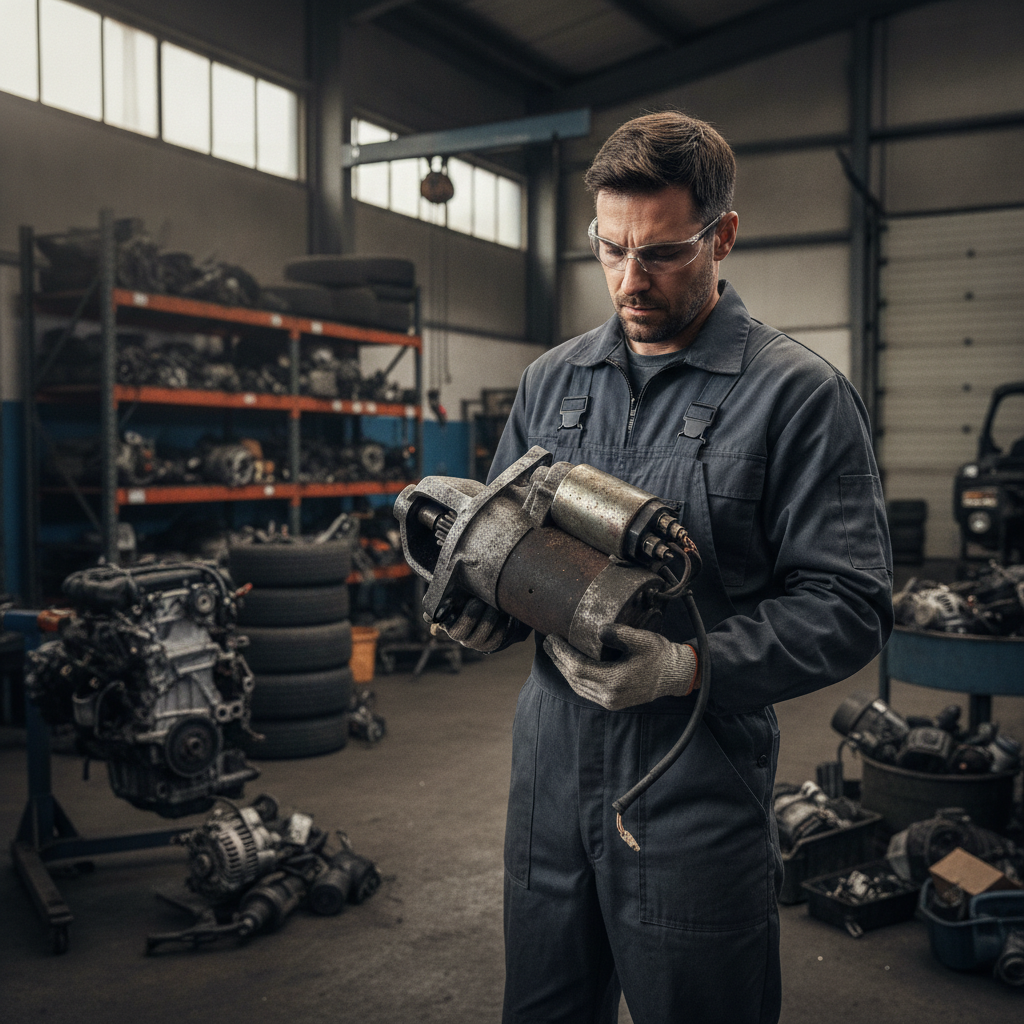
Examine the starter’s exterior housing for cracks or signs of extreme heat. If the metal casing shows a bluish tint, it may have been subjected to an electrical overheat. Inspect the mounting ears; if they are cracked or bent, the starter will not align correctly with the flywheel, leading to grinding noises and gear damage.
Check the electrical terminals on the solenoid. They should be clean, tight, and free of excessive corrosion. If the plastic cap on the solenoid is cracked, moisture can enter and cause internal short circuits.
2. Mechanical Inspection: The Bendix Drive and Pinion Gear
The pinion gear is the small gear that emerges to spin the engine. Inspect the teeth of this gear closely. They should have sharp, clean edges. If the teeth are rounded, chipped, or flattened, it indicates that the starter was improperly engaged or the previous vehicle had a damaged flywheel. A starter with a damaged pinion gear will eventually fail to engage or will damage your own vehicle’s flywheel.
3. The Manual Rotation Test
Try to spin the pinion gear by hand. In most designs, it should spin freely in one direction and lock in the other (this is the overrunning clutch mechanism). If it spins freely in both directions or is completely seized, the internal clutch or bearings are defective.
How to Perform a Bench Test
A visual check is essential, but a functional test provides the ultimate peace of mind. To bench test a starter, you will need a fully charged 12V battery and a set of jumper cables. Note: Secure the starter in a vise before testing, as the torque can cause it to jump off the workbench.
- Connect the negative (black) cable from the battery to the starter housing (ground).
- Connect the positive (red) cable to the large battery terminal on the solenoid.
- Use a small jumper wire to bridge the positive terminal to the smaller “S” (start) terminal.
When the connection is made, the pinion gear should kick out forcefully and spin rapidly. It should sound smooth and high-pitched. If it grinds, chatters, or spins slowly, the internal brushes or the solenoid are likely failing.
📹 Recommended Video
For a visual guide, search “how to bench test a car starter motor with jumper cables” on
YouTube.
Compatibility: Finding the Right Fit for Your Vehicle
Starters are not universal. Even within the same model year, different engine sizes (e.g., a 2.5L vs. a 3.5L) or transmission types (manual vs. automatic) often require different starter motors. When searching for used auto parts in Newark or Wilmington, always have your VIN (Vehicle Identification Number) ready. This ensures that the OEM parts you purchase from JP Auto Hub are an exact match for your vehicle’s mounting pattern and gear tooth count.
Sourcing from JP Auto Hub in the Mid-Atlantic Region
Finding a reliable starter doesn’t have to be a gamble. For residents in Camden, NJ, and Annapolis, MD, JP Auto Hub provides a curated selection of recycled car parts that have been professionally dismantled and stored. Unlike “pick-your-part” yards where components are exposed to the elements, our inventory is managed to preserve the integrity of electrical components like starters and alternators.
Benefits of Buying from JP Auto Hub:
- Expert Sourcing: We only stock parts from vehicles with verifiable histories.
- Local Expertise: We understand the specific needs of drivers in the Delaware and New Jersey areas, including the impact of road salt on electrical components.
- Customer Support: Our team is available to help you verify compatibility before you buy.
Conclusion
Buying a used starter is a brilliant way to save money while maintaining the high standards of OEM parts. By following the inspection steps outlined above—checking the pinion gear, inspecting the terminals, and performing a bench test—you can install your part with confidence.
If you are in Newark, Wilmington, Camden, or Annapolis and need a reliable replacement, don’t settle for subpar aftermarket components. Check our current inventory or contact us today at JP Auto Hub to find the perfect recycled starter for your car, truck, or SUV. Your vehicle deserves the best, and your wallet does too.





Copyright 2025 © J&P All right reserved. Powered by IzyoX
